The documents referenced in this post are included at the bottom
if you want to jump ahead.
The Function Looking For a Form
I have an iPad Pro. I have the Apple Pencil. I have a reMarkable — the one that was a Kickstarter before it was a product, the one that’s supposed to feel like paper, the one where if you get the upgraded pencil, you flip it upside down, and that’s the eraser. I love that detail. I do not regularly use any of them for what they were designed for.
It’s not that the tools are bad. It’s that my life runs on two systems that don’t speak to each other cleanly. Personally, Apple. Professionally, Windows — since 1999, every day, all day, 10,000 hours blown so far past the window I don’t even count anymore. I think in Windows. I know every shortcut key. When I needed to get my website going, I had to buy a new Windows laptop because the last one was eight years old and barely touched. That’s how bifurcated my world is.
So I have this iPad with a pencil I don’t use, and I have paper everywhere — sticky notes, random sheets, notebooks started and abandoned — and I have a brain that does not stop. Ever. If I go to a device to capture a thought, I risk losing hours. What does this look like? I’m watching TV, and something connects to a project I’m working on. I’m driving, and I’m mentally writing three different things at once. I’m washing dishes, and an idea arrives fully formed, and I have about four minutes before it dissolves.
The need has been there for a long time.
How do I capture a thought — just the nucleus, just the germ of it — without reinventing the wheel by writing it twice, once analog and once digital? Without getting pulled into a rabbit hole the moment I open a device? Without losing the idea entirely because I had nowhere to put it that was contained, concise, and mine?
A function looking for a form.
For years.
Keep reading — this is where the circumstances come in.
The Container
Here’s the part I don’t usually lead with.
I’ve had two stretches of time off in recent years. The first one I had plans for. Classes lined up. Learning queued. I took the first class and barely finished it. It turned out I was so burnt out I couldn’t think. Not tired — gone. It took ten months before I felt like myself again, before I could hold a thought long enough to do something with it. That was scary in a way I didn’t expect. I am someone who has to be learning. Always. I’ve been taking classes at San Diego Continuing Education since I got out of high school — first ROP, then whatever came next, cooking, fitness, web design, things that had nothing to do with work, and things that had everything to do with it. My unofficial transcript only goes back to 2015, and it is not short. Learning isn’t something I do for credentials. It’s something I do because I don’t know how not to.
So losing the ability to do it for ten months was disorienting in a way that’s hard to describe.
This time is different. I’m not burnt out. I’m here — fully, frustratingly, productively here. And yes, I would love to be working. I will not pretend otherwise. I’m someone who had a career that people reached out to me for. That is not this market. At some point, the crickets stop being personal and start being systemic, and you have to decide whether to live in that or build anyway.
I build.
My website started as a portfolio. It became a playground. There’s a difference. A portfolio shows what you’ve done. A playground is where you figure out what’s possible — where you take the things you’ve been learning, and you put them somewhere real to see if they hold. It’s where I take the thoughts that need an actual place to land.
That playground is where Threaded came from.
A portfolio shows what you’ve done.
A playground is where you figure out what’s next.
Keep reading — this is where the tools come in.
The Village
People talk about AI like it’s a vending machine. Put in a prompt, get an answer. That’s not how I work with it, and honestly, it’s not how it works best.
I wield it. There’s a difference between using a tool and wielding one. A sword lying on the ground can’t do anything. The person holding it determines everything — what gets built, what gets protected, what gets damaged. AI is the same. It has the power to extend what you’re capable of, to hold context you can’t hold alone, to be designed to push back to help clear your thinking when it gets muddy. It also has the power to flatten your voice, optimize you into someone generic, rewrite you into a LinkedIn post that sounds like every other LinkedIn post. The person wielding it determines which of those things happens.
Here’s what my village looks like:
| TYPE | TOOL | PURPOSE |
|---|---|---|
| AI tool | 🧠 Claude | I use it for the long thinking. The sessions that run for hours. The pushback when I’m not being precise. The naming — none of the pieces of Threaded came from me alone. They came from a conversation where I kept saying that’s not quite right until something landed. Claude can search your own threads and show you patterns you didn’t know you had. That’s not a small thing. |
| AI tool | 👁️ ChatGPT | I use it for a second opinion and for visuals. And here’s the thing about ChatGPT — it gave me an infographic that was so wrong it showed me exactly what right looked like. I couldn’t have articulated what I wanted until I saw what I didn’t want. That’s a real thing that happened and it mattered. |
| AI tool | 🔍 Perplexity | I use it when I need real world data. Citations. Verification. Because I don’t just think — I check. |
| Creative, Design, Execution tool | 🎨 Canva | I use this to make it real. To take what existed in conversations and documents and turn it into something you can hold up and show someone. AI is great but sometimes it can only do so much before its just easier to create the object yourself. |
And then me. My own eye knowing when the subtitle needed more air, when 22 point felt better than 24, when the charcoal was too harsh and needed to soften. No tool knew what the others were doing. I was the connective tissue. That and a lot of years doing it in so many contexts — learning design, operations, customer service, web development, teaching people how to use tools they didn’t ask for and didn’t think they needed. Years of sitting behind someone while they used something I built, watching where they hesitated, where they got lost, where they gave up. Years of caring enough to go back and fix it.
That’s not something you prompt your way into.
That’s the thing that was already in the toolbox.
That’s what wielding looks like.
No tool knew what the others were doing.
I am the connective tissue.
Keep reading — this is where it all comes together.
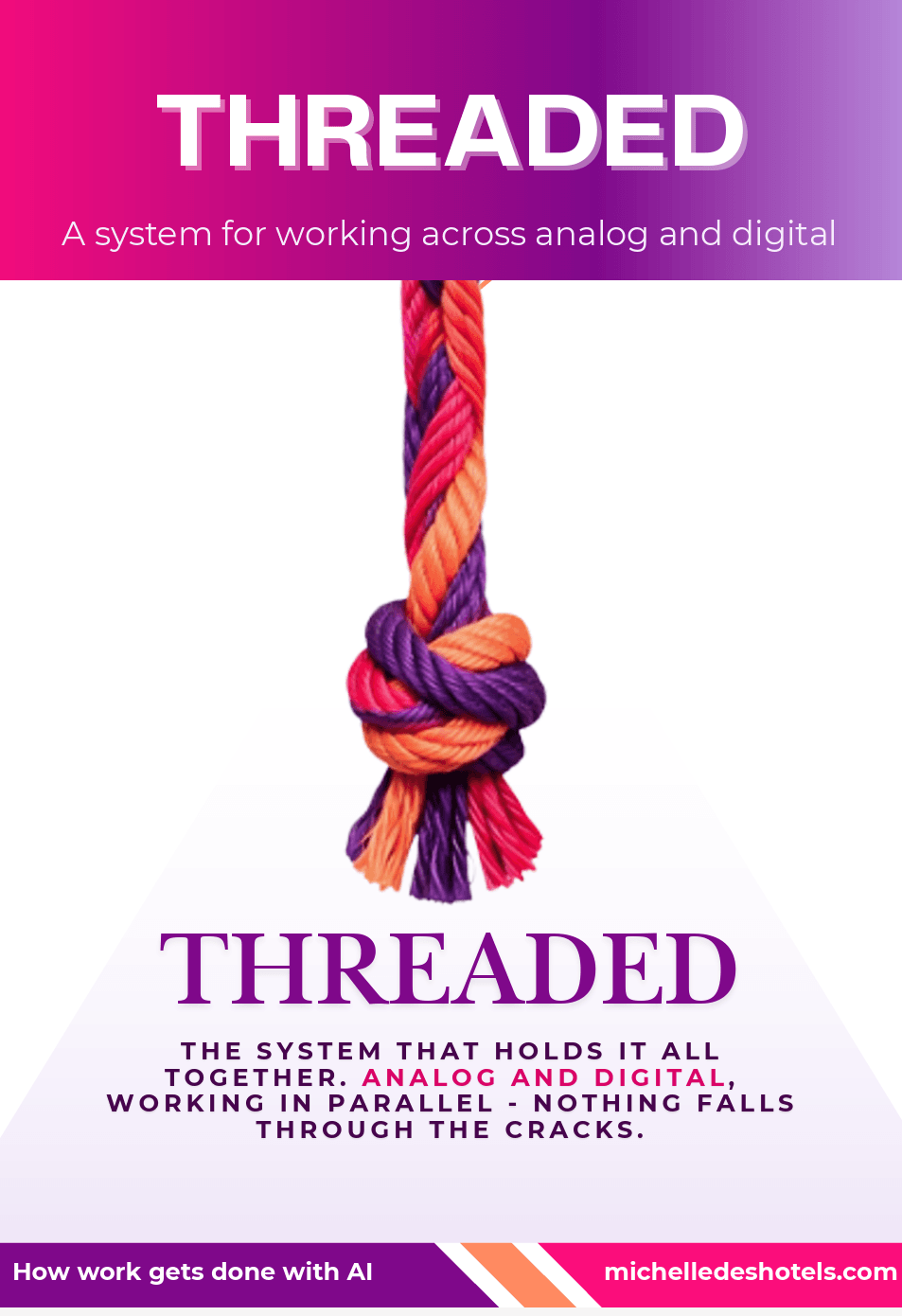
Threaded

It started with: I want a project sheet.
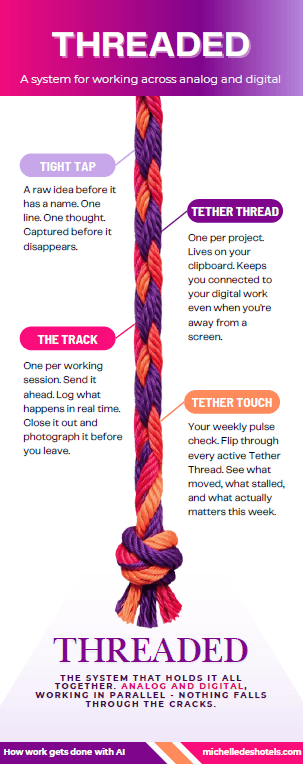
What came out was a named system with five printable documents, a visual identity built around a three-strand rope that knots at the bottom, and an infographic I made in Canva that I am genuinely proud of.
Built in one working session.
But that’s not quite right either. It didn’t come from one day.
It came from years of paying attention to how I work. It came from the iPad pencil I don’t use, but tried to for years. It came from the reMarkable that almost solved it, the sticky notes everywhere, and the two-hour drives where the thinking doesn’t stop. It came from finally having the time and the clarity and the tools to build the thing that the function had been looking for. Function looking for a form.
- 01 · Tight Tap — a raw idea before it has a name. One line. The nucleus. Because if I can’t remember the nucleus, I can’t remember anything else, and all I need is the germ to pick it up again later.
- 02 · Tether Thread — one per project. Lives on the clipboard. Keeps me connected to my digital work … the AI threads, the files, the decisions made — even when I’m away from a screen.
- 03 · The Track — one per working session. Three pages: send page one ahead so the other person comes prepared, log what happens in real time on page two, close it out, and photograph it before you leave.
- 04 · Tether Touch — the weekly pulse check. Flip through every active Tether Thread. See what moved, what stalled, and what actually matters this week. The back side scans the Tight Taps and closes the loop on the ones that were supposed to become something more.
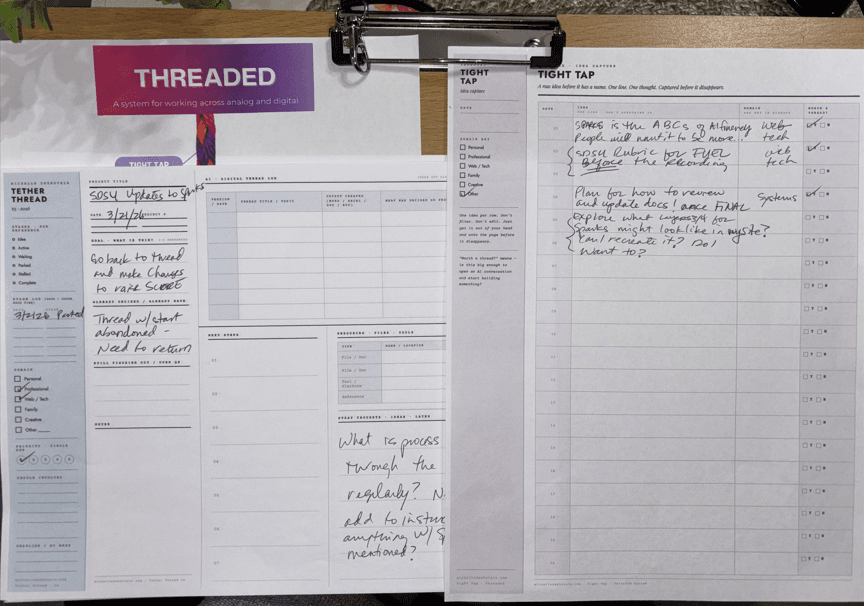
I know it works because the day after I finished building it I was washing dishes and an idea arrived. I didn’t run to my computer. I got my clipboard. I wrote the nucleus on the Tight Tap. I added a few notes to the Tether Thread for the project it connected to. And I walked away.
The idea is there.
It will be there when I come back.
…and I didn’t lose three hours to a rabbit hole 🕳️.
Keep reading — this part is really for you.
Wielding
The clearest technical advantage you have is
self-knowledge.
Not a soft idea. A technical one. The more clearly you understand how you think — what pulls you in, what shuts you down, what you need to capture, and what you can let go — the more AI can amplify it. Because AI is responsive. It meets you where you are. If you’re vague, it gives you vague. If you’re scattered, it gives you scattered. If you know yourself, it gives you something that sounds like you, thinks with you, and builds with you.
I’ve been taking classes my whole life, not because someone told me to, but because I don’t know how to stop. I’ve been trying to solve the analog-digital problem for years. I came back from burnout and built a portfolio that became a playground. I spent time in a job market that doesn’t seem to know what to do with someone like me, and I built anyway.
The version of me that comes out on the other side of this will have done and learned more than the one who went in. That’s not spin. That’s just true.
If you don’t know where to start — ask AI to look back through your own work. It will show you patterns you didn’t know you had.
Where form meets function and ignition meets fire.
THIS is what using AI on purpose looks like. Everyone’s version looks different.
Because nobody knows you better than you. And more importantly:
I don’t have to go to my device to stay in my work.
Why Did I Write This?
Someone made me aware that there might be at least one person reading this who needs to hear it.
The documents are below. Not because I think you’ll use them exactly as I did — but because maybe they become the germ of something for you. Maybe you look at them and think that’s not quite right for me, and that’s enough. That’s how I got here. Someone else’s wrong answer pointed me toward my right one.
Take what’s useful. Leave the rest.
Threaded
Overview
The one page explanation of the entire system 📄
Tight
Tap
Raw idea capture 📄
Tether
Thread
One per project 📄
The
Track
One per working session,
three pages 📄
Tether
Touch
Weekly review,
two-sided document 📄
Threaded Infographic
The visual identity
of the system 📄
Michelle Deshotels · deshotels-custom-theme.local/ · SPARKS Method · FUEL · Threaded